 Image 1 of 1
Digital download — delivered as an editable Microsoft Word (.docx) file immediately upon purchase.Compatible with Microsoft Word and Google Docs.
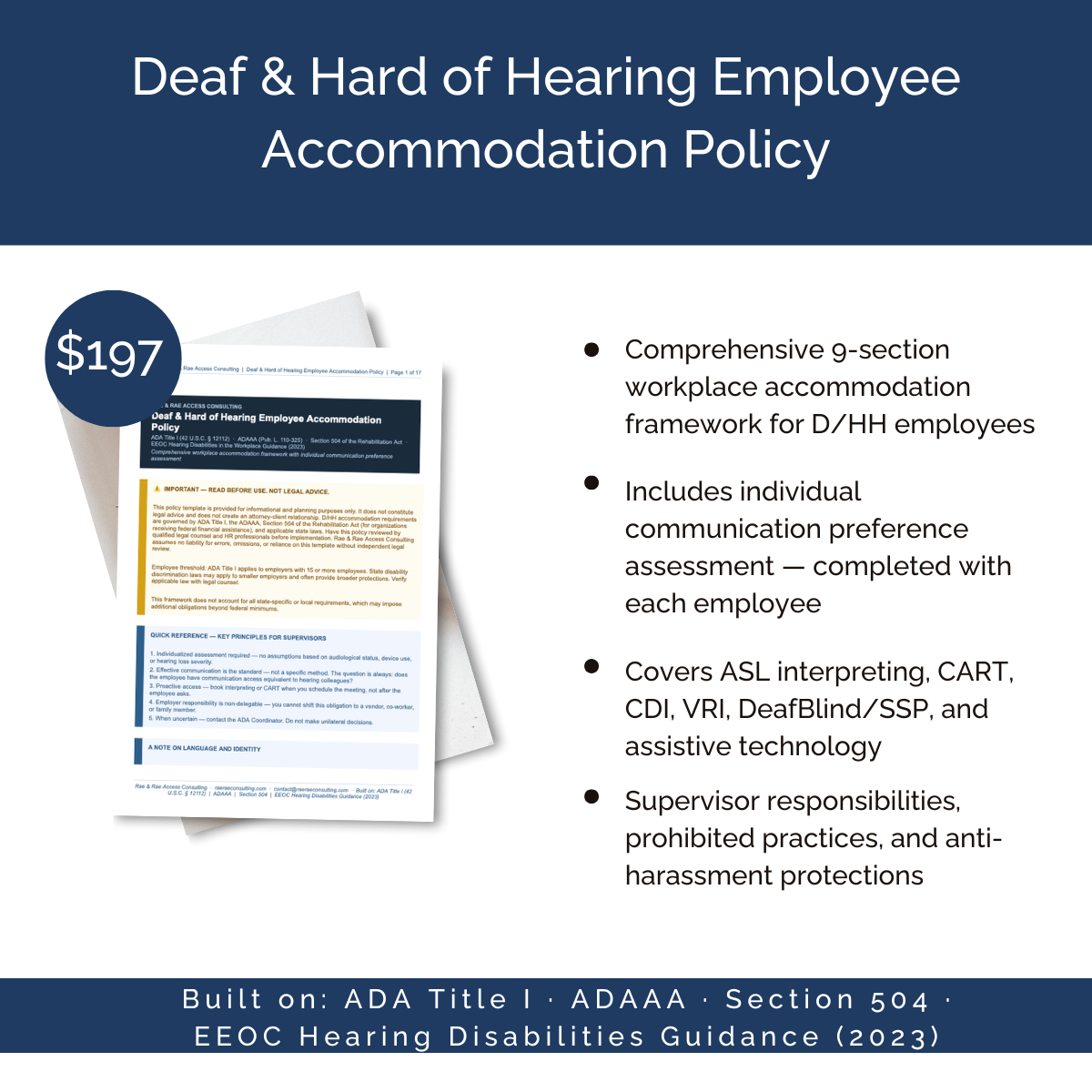
Most workplace accommodation policies treat Deaf and Hard of Hearing employees as an afterthought — a checkbox, not a framework. This policy was built by a Deaf compliance professional who understands that communication access is not one-size-fits-all. It gives your organization a complete, individualized framework for supporting D/HH employees across every aspect of employment — from onboarding through professional development, discipline, and beyond.
What's included:
Section 1 — Purpose, scope, and key definitions
Section 2 — Communication access framework: ASL interpreting, CART, remote access, emergency notifications, assistive technology, and DeafBlind/SSP accommodations
Section 3 — Professional development and equal opportunity protections
Section 4 — Supervisor responsibilities and training requirements
Section 5 — Prohibited practices with disciplinary consequences
Section 6 — Individual communication preference assessment (completed with each D/HH employee at onboarding and updated annually)
Section 7 — Accommodation request timelines and undue hardship standards
Section 8 — Harassment protections, complaint process, and anti-retaliation
Section 9 — Policy administration and version control
Language and identity guidance — Deaf culture, deaf, Hard of Hearing, Late-Deafened, DeafBlind
CDI guidance, auto-caption limitations, and note-taking prohibition
Who this is for:
HR directors, ADA Coordinators, and compliance staff at any organization with Deaf or Hard of Hearing employees — healthcare organizations, FQHCs, community health centers, Deaf-serving organizations, schools, and employers of any size who want to get this right.
Built on: ADA Title I (42 U.S.C. § 12112) · ADA Amendments Act of 2008 (Pub. L. 110-325) · Section 504 of the Rehabilitation Act · EEOC Hearing Disabilities in the Workplace Guidance (January 2023)
These templates are provided for operational and compliance guidance purposes only and do not constitute legal advice. Organizations should review all compliance documentation with qualified legal counsel prior to implementation. Rae & Rae Access Consulting LLC makes no representations that these templates satisfy all applicable legal requirements in every jurisdiction.
Minor corrections and formatting updates are provided to all previous purchasers at no charge. When changes in law, regulation, or agency guidance require a substantive revision, updated versions are available to previous purchasers at 50% off the current price. Clients on a Consulting Access Retainer or Quarterly Compliance Partnership receive all substantive updates automatically as part of their engagement. To receive update notifications, ensure your purchase email is current.
Digital download — delivered as an editable Microsoft Word (.docx) file immediately upon purchase.Compatible with Microsoft Word and Google Docs.
Most workplace accommodation policies treat Deaf and Hard of Hearing employees as an afterthought — a checkbox, not a framework. This policy was built by a Deaf compliance professional who understands that communication access is not one-size-fits-all. It gives your organization a complete, individualized framework for supporting D/HH employees across every aspect of employment — from onboarding through professional development, discipline, and beyond.
What's included:
Section 1 — Purpose, scope, and key definitions
Section 2 — Communication access framework: ASL interpreting, CART, remote access, emergency notifications, assistive technology, and DeafBlind/SSP accommodations
Section 3 — Professional development and equal opportunity protections
Section 4 — Supervisor responsibilities and training requirements
Section 5 — Prohibited practices with disciplinary consequences
Section 6 — Individual communication preference assessment (completed with each D/HH employee at onboarding and updated annually)
Section 7 — Accommodation request timelines and undue hardship standards
Section 8 — Harassment protections, complaint process, and anti-retaliation
Section 9 — Policy administration and version control
Language and identity guidance — Deaf culture, deaf, Hard of Hearing, Late-Deafened, DeafBlind
CDI guidance, auto-caption limitations, and note-taking prohibition
Who this is for:
HR directors, ADA Coordinators, and compliance staff at any organization with Deaf or Hard of Hearing employees — healthcare organizations, FQHCs, community health centers, Deaf-serving organizations, schools, and employers of any size who want to get this right.
Built on: ADA Title I (42 U.S.C. § 12112) · ADA Amendments Act of 2008 (Pub. L. 110-325) · Section 504 of the Rehabilitation Act · EEOC Hearing Disabilities in the Workplace Guidance (January 2023)
These templates are provided for operational and compliance guidance purposes only and do not constitute legal advice. Organizations should review all compliance documentation with qualified legal counsel prior to implementation. Rae & Rae Access Consulting LLC makes no representations that these templates satisfy all applicable legal requirements in every jurisdiction.
Minor corrections and formatting updates are provided to all previous purchasers at no charge. When changes in law, regulation, or agency guidance require a substantive revision, updated versions are available to previous purchasers at 50% off the current price. Clients on a Consulting Access Retainer or Quarterly Compliance Partnership receive all substantive updates automatically as part of their engagement. To receive update notifications, ensure your purchase email is current.